Five things a used car's service history booklet tells you that the odometer cannot — a Sydney buyer's reading guide
The stamped pages in that booklet reveal what the seller never volunteers — here's how to read every one.
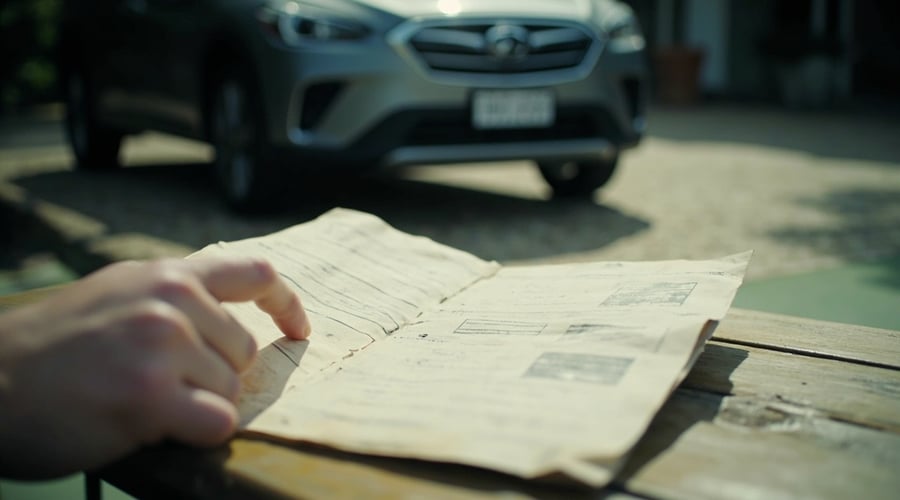
Most buyers glance at a service booklet, count the stamps, and decide it looks "complete". That's roughly like counting the pages of a contract without reading the clauses. The booklet is actually one of the most useful documents you'll handle in a private-sale negotiation — but only if you know what to look for beyond the stamp count. Give it fifteen focused minutes and it will tell you things the odometer physically cannot.
Here is how to read one properly, in Sydney, before you spend anything on a third-party inspection.
What a "full service history" actually means — and why the phrase is nearly useless
Sellers and ads use "full service history" the way estate agents use "cosy" — as a feel-good phrase that commits to nothing specific. A logbook with twenty stamps is not automatically better than one with twelve. What matters is the internal consistency of the document: do the dates, the kilometres, the workshop locations and the stamp details form a coherent, continuous story? Every piece should fit the next.
The first thing to check is whether the booklet is the original issued with the car, not a blank replacement bought from an accessories shop. Genuine manufacturer booklets have the VIN or engine number pre-printed inside the front cover for models produced after a certain year; some have serial numbers on the cover itself. If the car is a Japanese-market import (common in Sydney's Alphard and Hilux Surf trade), the booklet may be entirely in Japanese — which is fine and actually a good sign of authenticity, but you will need to cross-reference the service intervals differently. A suspiciously clean, generic black-and-white booklet with no branding and no pre-printed VIN on a car that claims to have been "dealer-maintained since new" is worth querying.

Red flag one: kilometres that defy physics
Open the logbook and build a simple table in your head — or on your phone's notes app — of every service entry: the date and the recorded kilometre reading. Then do the arithmetic.
A car used in Sydney's typical suburban pattern will cover roughly 12,000 to 18,000 kilometres per year on average. A car with one owner in the inner west commuting to the CBD might be lower — say 8,000 to 10,000 a year. A tradie's ute or a family's only car will be higher. The point is not to catch anyone on exact numbers; it is to catch implausibility.
If the logbook shows 15,000 km at the first service and 16,200 km at the second service eighteen months later, that is less than 1,000 km in a year and a half. That is possible — but it needs a story (long overseas trip, car laid up). No story? Ask for one. If the seller cannot explain it, the gap becomes a red flag, not a curiosity.
The more dangerous version runs the other way: a big jump between two services that is not acknowledged by the seller. Say the car sits at 48,000 km through three services, then at the fourth entry it reads 61,000 km — but only six months have passed. That is 13,000 km in six months at the same interval the car was doing 3,000 km per six months before. Either driving patterns changed dramatically (new job, new city), or someone serviced the car before resetting an odometer and forgot to change the logbook entry to match.
This is the single most actionable thing in this article: do the arithmetic on every consecutive pair of entries. It takes three minutes and it is completely free.
Red flag two: workshop inconsistency that doesn't match the seller's story
Every service stamp has a name on it — a dealer name, an independent workshop, or in some cases just a handwritten signature and a phone number. Plot those geographically against what the seller tells you about the car's history.
A car that "has only ever been in Sydney" should have Sydney workshops in the logbook. If you see a Canberra dealer stamp, a Melbourne independent, and then a Sydney entry, the car has moved — not necessarily a problem, but the seller should account for it. A car that "came straight from the dealer, one owner, never left the inner west" should not have a stamp from a workshop in Campbelltown unless the owner used to live there.
This catches a specific and common practice: a logbook transplanted from a similar model. The VIN pre-printed in the front doesn't match, but beyond that, the geographical trail of workshops often doesn't match the seller's claimed ownership story either. Ask the seller where they lived when each service was done. If the answer doesn't line up with the stamps, you have something worth probing before you book a pre-purchase inspection.
Also look at the workshop types across the life of the car. A car serviced at the manufacturer's dealer for the first six services and then switched to a reputable independent is completely normal — most owners do this once the statutory warranty expires. A car serviced at the dealer up to 50,000 km and then nothing — no stamps at all — for the next 70,000 km, with the seller claiming "I just kept up with it myself", is a much harder story to accept. Gaps of more than 18 months with no recorded service on a car covering normal mileage are worth treating as absent history, not incomplete history.

Red flag three: the stamps themselves — what a real one looks like
A genuine workshop stamp is inked, usually slightly imperfect, and contains at minimum: the workshop's name, an ABN or address, the date, and the technician's signature or initials. Some dealer stamps also include the service advisor's name.
Counterfeit stamps exist. They are rarer than odometer tampering via the electronic module, but they happen — particularly in private sales of higher-kilometre prestige cars where a clean-looking logbook adds several thousand dollars to the perceived value. Signs of a fake stamp:
The ink is too sharp and uniform, with no bleed. Real rubber stamps on paper bleed very slightly at the edges. A stamp that looks typeset — perfectly even, no slight rotation — may have been printed rather than stamped.
The date is inconsistent with surrounding entries. A stamp for a service "in 2019" that uses a format common to a European model but the workshop ABN traces to a business that was not registered until 2021 (you can check ABN registration dates at abn.business.gov.au for free) is deeply suspicious.
The kilometre entry is in a different pen or handwriting from the rest of the page. Minor variation between pages is normal — different service advisors write differently. A page where everything matches except the odometer reading, which has been written over or written in a noticeably different hand, is worth scrutiny.
Red flag four: what the logbook omits that should be there
Most manufacturer logbooks have pages at the back for major repairs, campaigns (factory recalls), and additional notes. Check whether any of those pages have been used — or torn out. A car that has been through a recall campaign should have that campaign noted somewhere; you can cross-check recall history independently at vehiclerecalls.gov.au or with the manufacturer.
More directly relevant: the logbook often has a section for tyre replacements, brake pad replacements, and major repairs. If the car has 90,000 km on it and the tyre page is entirely blank, either the tyres have never been changed (unlikely and a separate concern) or the owner has not been logging things they should have. Neither is automatically disqualifying, but it tells you that this document has been used selectively, not comprehensively.
Also look at service types. Manufacturer logbooks distinguish between minor services (typically oil and filter) and major services (which add brake fluid, transmission oil, spark plugs, air filter and more). A car with 100,000 km that shows only minor service stamps — every single one — has either had its major services done without being stamped, or has not had them done at all. A car in that condition will need significant mechanical attention; factor that into the negotiation, or get the independent inspection to confirm the actual state of those components.

Red flag five: the gap between the last stamp and today
This one is simple and routinely overlooked. When was the last service entry? If the car is being sold at 87,000 km and the last stamp was at 71,000 km, sixteen thousand kilometres have passed with no recorded service. Either those services were done and not logged, done at a workshop that doesn't stamp booklets (this happens at some quick-service chains, though they should provide a receipt), or — most commonly — not done at all.
Ask for receipts. Any service, whether stamped in the logbook or not, should produce a tax invoice from the workshop. A seller who says "I always kept up with the servicing" but cannot produce a single receipt for the last 16,000 km has, functionally, no service history for that period. That is not a deal-breaker, but it should shift the negotiation, and it absolutely changes what your pre-purchase inspection needs to focus on.
What to do with what you've found — the Sydney-specific next steps
If the logbook passes your arithmetic and visual checks, you are not done — you are better prepared. The logbook tells you what the seller has recorded; the PPSR (ppsr.gov.au) tells you what the government has on file. Run the car's VIN and plate before you go further. A PPSR check costs around $2 and returns written-off status and finance encumbrances — but no odometer readings. For odometer cross-referencing, run Service NSW's free rego check, which shows the three most recent yearly odometer readings (if available). If the rego records show the car at 105,000 km in 2022 and the seller is showing you a logbook that reads 89,000 km today, you have your answer without needing anyone else.
Service NSW's vehicle history lookup (service.nsw.gov.au) also records inspection history. It won't give you every kilometre reading, but it gives you timestamps that let you check plausibility against the logbook's own dates.
If the car has survived all of this — logbook consistent, PPSR clear, rego history plausible — then a third-party pre-purchase inspection is your next and most important step. Book it with an independent mechanic, not one the seller recommends. In Sydney, there are a number of NRMA-affiliated and independent workshops that offer this service for $150 to $250 depending on the car type; it is always money well spent on a private purchase over $15,000.

The one honest trade-off
The logbook check described here catches inconsistencies and triggers the right questions. It will not catch every problem. A sophisticated odometer rollback on a modern car with an electronic instrument cluster may leave the logbook looking internally consistent — because the person who rolled it also corrected the service entries. What the logbook cannot defeat is Service NSW's odometer records and an independent mechanic's physical inspection. Use the logbook as your first filter and your questioning tool; use those two other checks as the verification layer.
How a proper dealer should handle this — and what to ask
When you buy from a licensed dealer registered with NSW Fair Trading (rather than a private seller), you have statutory warranty protections under the Motor Dealers and Repairers Act 2013, and the dealer is obligated to disclose known defects. At our workshop in Concord, every car that comes in gets a PPSR check the day it arrives, and the logbook gets read against the rego history before it goes near the lot. If there are gaps, we either account for them with service receipts or we price and disclose accordingly.
That is what "full service history" should actually mean — not just a booklet with stamps in it, but a booklet that has been cross-checked and can be explained, entry by entry.
If you are looking at a used car and want to talk through what you've found in the logbook, bring it in or describe it in the comments. We have been doing this since 2013 and there are very few logbook configurations we haven't seen.