Sydney Used Cars — "All OEM Parts" vs "Repaired with Aftermarket Parts": How Much Does That Service History Entry Actually Cost You Over Time?
One line in a service history can quietly double your repair bill three years from now.
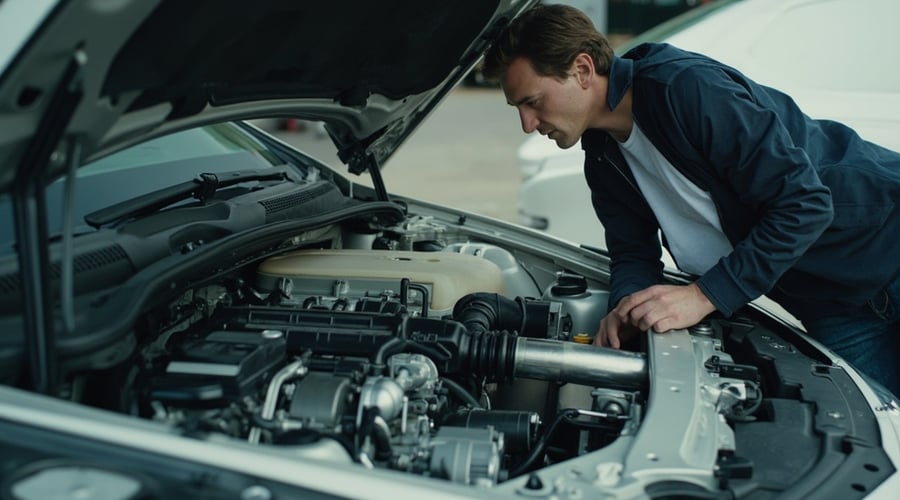
You're looking at two nearly identical 2019 Mazda 3s. Same colour, similar kilometres, similar asking price. One service history says "oil change, air filter replaced — OEM parts used." The other just says "oil change, air filter replaced." Or worse: it says "repaired, parts supplied by customer."
Most buyers read those entries and move on. That's the expensive mistake.
What's actually written in a service history — specifically what parts went in — can reshape your repair costs for years after you drive away. This isn't theoretical. It's something our M&F workshop team sees play out on cars that come in for mechanical checks before we put them on the floor. The car looks fine. The history looks complete. And then you get the thing up on a hoist and start looking at what's actually installed.
Here's what those entries actually mean, and the one question that cuts through the noise.
What "OEM" and "Aftermarket" Actually Mean on a Service Record
OEM stands for Original Equipment Manufacturer. For a Toyota, that means Toyota-sourced parts — or parts made by the same suppliers Toyota uses, sold through Toyota channels. For a Mazda, same story. The part was engineered to the exact tolerances the factory specified, and the materials were tested against the operating conditions of that specific engine and drivetrain.
Aftermarket means parts made by a third party. This isn't automatically bad. Brands like Bosch, NGK, Denso, and Ryco make aftermarket components that meet or exceed OEM spec for many common wear items — air filters, spark plugs, brake pads, fuel filters. A good independent workshop in NSW will use these routinely, they're perfectly legitimate, and in some cases they're better than OEM for specific applications. NGK iridium plugs in certain engines, for instance, outlast OEM plugs by a meaningful margin.
The problem is that "aftermarket parts" is a category that ranges from Bosch brake rotors (fine) to unbranded components with no certification documentation, no traceable origin, and no listed service interval (not fine). And a service history entry almost never tells you which one. The stamp goes in the book either way. "Brake service completed" looks identical whether the workshop used Brembo pads and EBC rotors or a bag of parts that arrived in a box with no brand name on it.
So the real question isn't "OEM or aftermarket?" It's: which aftermarket, and for which component?
Where It Gets Expensive: The Parts That Actually Matter
Some components, it genuinely doesn't matter much. A generic air filter does essentially the same job as an OEM one — the flow characteristics are similar, the filtration media is comparable, and the consequences of a slightly suboptimal filter are negligible over a normal service interval. Wiper blades, cabin filters, basic fluid top-ups — the aftermarket equivalent is usually fine and your wallet will thank you for not insisting on dealer parts.
The parts where it matters are a different story.
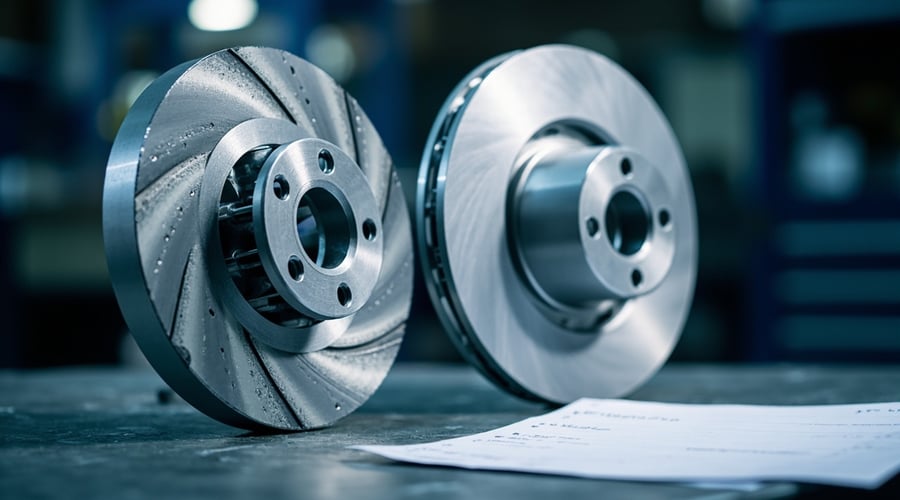
Brake components. A cheaper rotor that's slightly out of tolerance — even by half a millimetre in thickness variation — creates a hotspot that warps under heat. You won't feel it for six months. By the time you notice a shimmer in the pedal under hard braking, you've already cooked the pads unevenly and the rotor surface is scored in a pattern that won't clean up. What would have lasted another 40,000 km gets condemned at 15,000. A caliper bracket that's slightly undersized in its bore doesn't retract cleanly, which means a pad that's dragging when it shouldn't be — you'll notice it as a pulling sensation or smell it as heat after a long run down the M1 from the Central Coast.
Timing components. On interference engines — which covers the majority of modern petrol engines you'll find in the $15,000–$50,000 used car market in Sydney — a timing belt kit or chain tensioner made from lower-grade material carries a failure risk that the service history won't warn you about. The log might say "timing belt replaced at 90,000 km, 2021." What it won't say is whether the kit was a Gates or Dayco unit with a documented 100,000 km or 5-year service interval, or whether it was an unbranded kit sourced from a supplier the original workshop can no longer name. A no-name belt looks exactly like a branded one for the first 50,000 km. The difference shows up when it doesn't. On an interference engine, that means bent valves at minimum, sometimes a destroyed engine. The repair bill starts at $3,000 and climbs from there.
Suspension bushings and control arms. These affect geometry in ways that are slow to show up and easy to misread. A softer-than-spec rubber compound in a lower control arm bushing lets the arm flex slightly under cornering loads. The car doesn't feel dramatically different to drive — maybe a touch vague at highway speeds. But your rear inner tyres are wearing at twice the normal rate. After 18 months and two tyre replacements, nobody's connecting the dots back to the $45 bushing kit someone installed three years ago. At $200–$300 per tyre on a mid-sized car, the maths adds up faster than you'd expect.
Engine seals and gaskets. This is the category that produces the most insidious long-term costs because the failure mode is slow and easy to dismiss as normal aging. A valve cover gasket made from the wrong rubber compound for the engine's operating temperature begins weeping oil within 12–18 months of installation. Not a pour, just a seep — a faint smell on a hot engine, a slight discolouration around the valve cover edge. The previous owner either didn't notice or noticed and sold the car before it became their problem. By the time it's visibly wet, oil is finding its way onto belts and seals downstream. A gasket that should cost $60–$90 to replace turns into a $400–$600 job once you're accounting for the secondary damage.
The Real Cost Calculation
Let's be direct about numbers, because this is where buyers make the mental error of treating the purchase price as the only variable.
Say a car's previous owner saved $150 by using cheaper aftermarket brake components instead of OEM or quality aftermarket equivalents. That saving accelerated rotor wear by roughly 15,000 km — a conservative estimate based on the kind of wear patterns our M&F technicians see regularly. A rotor replacement on a mid-sized sedan at an independent workshop in Sydney currently runs $200–$400 per axle for parts and labour, depending on the vehicle and the workshop. The $150 "saving" cost you more than twice itself on one axle alone. On both axles, you're looking at $400–$800 for a problem that originated in a $150 decision you had no part in making.
Now multiply that across two or three components — brakes, suspension, a timing service — over a car's service history, with two or three previous owners each making similar decisions. The numbers stack in a way that doesn't show up in the asking price but shows up very reliably in your first 18 months of ownership.
This is precisely why we don't just read whether a car has service history when it comes into M&F. We read what it says, and then we look at the physical components on the car to see if what was recorded matches what's actually there. The two don't always agree.
The One Question That Gets You the Answer
When you're inspecting a used car, you can ask the seller: "Do you have the receipts for the parts used in these services?"
Not the service log. Not the stamp. The actual invoices or workshop receipts that show what was ordered, from which supplier, and ideally the part number.
A legitimate workshop — whether it's a dealership, a licensed independent, or us — keeps records of what was ordered. Those receipts show the supplier name, the part number, and in most cases the brand. If the answer is "I'll have to look for them" and they never materialise by the time you're ready to make a decision, that tells you something worth knowing before you hand over a deposit. It doesn't mean the car is bad. It means you're buying on faith rather than documentation, and you should price that into your offer accordingly.
If the receipts come out and show recognisable brand names with legible part numbers — Gates timing kit, Bendix brake pads, Ryco filter, whatever it might be — you're in a substantially better position. You can look up that part number, verify the service interval, and confirm that what the log says happened actually matches what was installed.
For cars that have been through a single owner and serviced consistently at a Mazda or Toyota dealer, this is straightforward — the dealer can pull the full parts and labour history from their system, often going back to the car's first scheduled service. For multi-owner private sale cars, it gets harder with each change of hands. That's when you have to take the other route: a proper pre-purchase inspection by a mechanic who can physically assess whether the installed components look like quality parts or not, and whether the wear patterns on consumable items are consistent with the kilometres on the clock.
In NSW, you can arrange a third-party pre-purchase inspection (PPI) through independent workshops — some mobile services will come to wherever the car is parked. Budget roughly $200–$350 depending on the depth of the inspection and whether it includes a hoist check. That's not a trivial amount. It's also the best $200–$350 you'll spend if it surfaces a brake system full of unbranded components on a car with 90,000 km and a service history that says everything was done but can't tell you what was used to do it.
What We Do Before a Car Gets On Our Floor
Every car we take in goes through M&F — our own workshop, on site at Concord — before it gets a price tag. Part of what that process does is check whether what the service history says matches what we can physically see and measure.
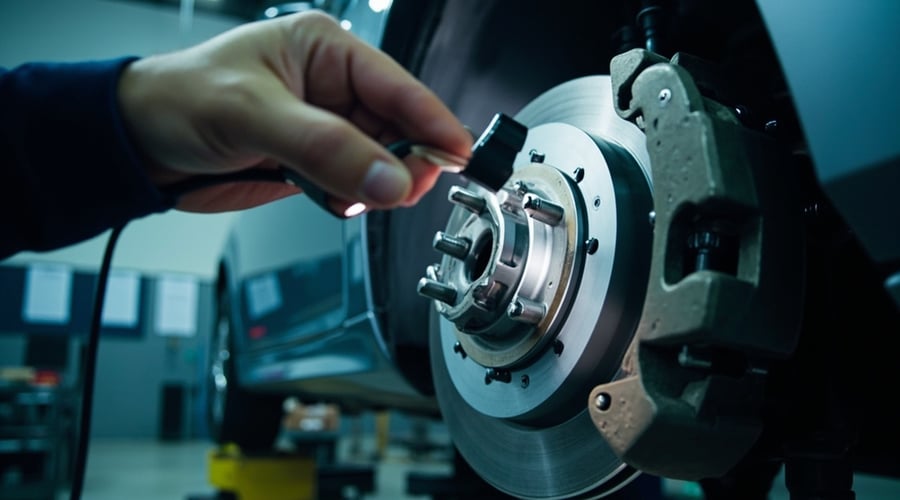
Timing components that look newer than the mileage would suggest? We identify the brand where we can and assess the condition against expected service life. If we can't confirm the brand, we treat it as unknown — which affects the price we're willing to put the car on the floor at, and what we do before it goes up. Brake components showing unusual wear patterns inconsistent with recorded service intervals? We look at rotor thickness, surface condition, and caliper movement, and we try to work out whether the wear we're seeing matches the history we've been given. Sometimes it does. Sometimes there's a gap of 20,000–30,000 km that nobody documented. Seals weeping in a way that's inconsistent with the car's age and stated history? That gets factored into whether the car goes on the floor at all, and if so, at what price after we've sorted it.
We've had cars come through that look excellent on paper — full log book, consistent service intervals, presented well — and turn out to have a timing component we weren't satisfied with on closer inspection. Those cars either get the component replaced before they're listed, or they don't get listed until we've resolved what we found. It's not a heroic policy. It's just the only way to stand behind a 3-month warranty without burning the relationship before it starts. If we knowingly put a car on the floor with a component we have doubts about and it fails at 60 days, we own that — financially and reputationally. The check is cheaper than the outcome.
The Honest Bit: This Isn't Always Visible
One thing worth saying clearly: even an experienced technician can't always determine whether a part is OEM or a quality aftermarket equivalent just by looking at it. Some aftermarket parts are manufactured to look identical to OEM, right down to the housing colour and surface finish. Some are genuinely equivalent in performance. The only reliable way to know is documentation — receipts, part numbers, supplier records that can be traced.
Which means a car with a thorough, documented service history from a reputable workshop is worth meaningfully more than the same car serviced at a rotating cast of different places with no paper trail and no receipts. That's not paranoia on the buyer's part. That's just how information — and the lack of it — prices into risk in this market. When you buy a car with no documentable parts history, you're not necessarily buying a bad car. You're buying uncertainty, and uncertainty has a cost that shows up eventually.
If you're looking at two similar cars and one has full documented service history from a consistent source and the other has a collection of stamps from five different workshops over eight years with no supporting paperwork, the asking price difference between them is almost always smaller than the actual risk difference. That gap is where a lot of buyers get hurt — not by outright fraud, but by the ordinary accumulation of undocumented decisions made by previous owners who were trying to save a bit of money.
Before You Buy: The Practical Checklist
When you're at the inspection stage, run through this before you decide whether to proceed:
-
Ask for receipts, not just the service log — specifically for any brake, timing, or suspension work
-
Look at recently replaced visible components (brake rotors, air filter housing) for recognisable brand names or part numbers
-
Check tyre wear pattern across both axles — uneven wear, particularly on inner edges, can indicate suspension component issues going back years
-
For higher-mileage cars (80,000 km+), ask specifically what was done at the last major service and whether the timing system has been inspected or replaced, and with what
-
If the car has bodywork repairs noted anywhere in the history, ask whether the adjacent mechanical components — particularly suspension and subframe — were inspected and what parts were used if any replacement was done
And if none of this can be documented to a standard you're comfortable with: factor a PPI into the decision. The $200–$350 cost of a pre-purchase inspection at a reputable independent workshop in Sydney is a known, fixed expense you can plan for. The unknown expense of discovering three months in that the front brake calipers need replacement, the timing belt kit is unbranded and overdue, and the rear bushings are soft — that's not fixed, and it's not small.
If you've got a specific car you're considering and want to talk through what a proper mechanical check would cover before you commit, send us a message. We're not in the business of selling you a car you didn't choose — but we can tell you whether what's in front of you adds up, and what questions are still worth asking before you sign anything.