「Weld Marks on the chassis」on a Sydney Used Car — Acceptable Repair or Walk Away? How Our Workshop Decides
Three welds under a car tell three very different stories — here's how to read them.

Most people buying a used car in Sydney spend a lot of time looking at the paint. Fair enough — a respatch is visible, a colour mismatch under sunlight at Parramatta Road is a giveaway, and most buyers have learned to look. What almost nobody does is get underneath.
Under the car is where the real history lives. A resprayed door is cosmetic. A welded chassis rail is structural. And the difference between those two things — in terms of safety, ongoing cost, and what the car is actually worth — is enormous. The frustrating part is that not every weld under a car is a red flag. Some repairs are done to a standard that is genuinely safe and acceptable. Others aren't. And without knowing what you're looking at, you can't tell the difference from the footpath.
This piece is based on what our M&F workshop team actually looks at when a car comes in for pre-purchase inspection. Not theory — the specific things they check, the specific signs they've learned to read, and the framework we use to decide whether a car goes on the lot, goes back to the seller, or goes to a buyer with a frank explanation of what's there.
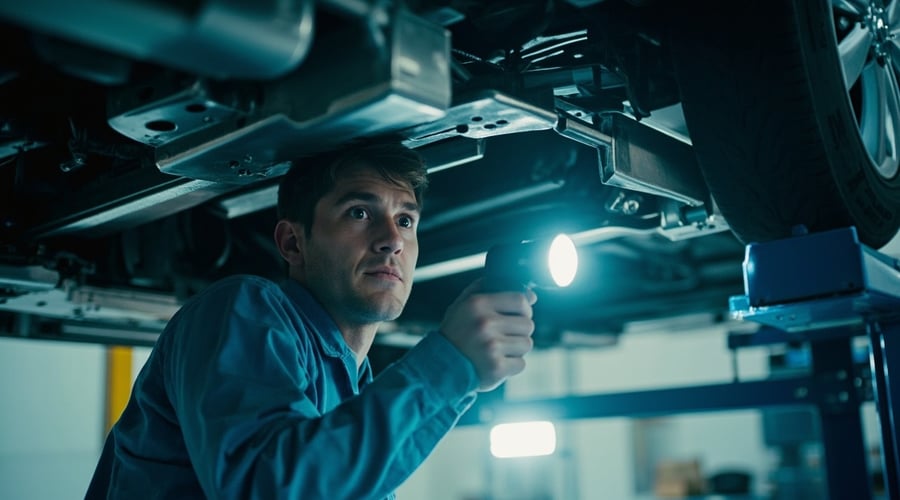
Why the Underside Gets Missed — and Why That Matters in Sydney
Private sellers in Sydney aren't legally required to disclose prior structural repairs under the Motor Dealers and Repairers Act 2013 in the same way licensed dealers are. A licensed dealer registered with NSW Fair Trading has disclosure obligations around known defects — a private seller selling their personal vehicle does not carry the same statutory burden. That gap is where structural repairs disappear.
Beyond legality, there's a practical reason: most buyers and even some dealers don't put the car on a hoist. A quick look under with a torch in a driveway tells you almost nothing. Proper chassis inspection needs a two-post lift, good lighting, and someone who knows what unrepaired, factory-joined metal looks like versus what has been cut and re-welded after impact.
The three areas that matter most — and that come up again and again in our inspections — are the chassis rails (the main longitudinal members running front to back under the floor), the guard or wing panels at the front corners where they meet the firewall and inner guard structure, and the sill sections (the box section running along each side between the front and rear wheels). Each tells a different story about what kind of accident happened and what was done about it.
Chassis Rail Welding: The Line Between Repairable and Not
The chassis rail is load-bearing. In a front or rear impact, the rail is designed to crumple in a controlled way — that controlled deformation is what absorbs energy and protects occupants. Once a rail has crumpled and been cut out and re-welded, it does not crumple the same way again. Whether that matters depends entirely on how it was done and where.
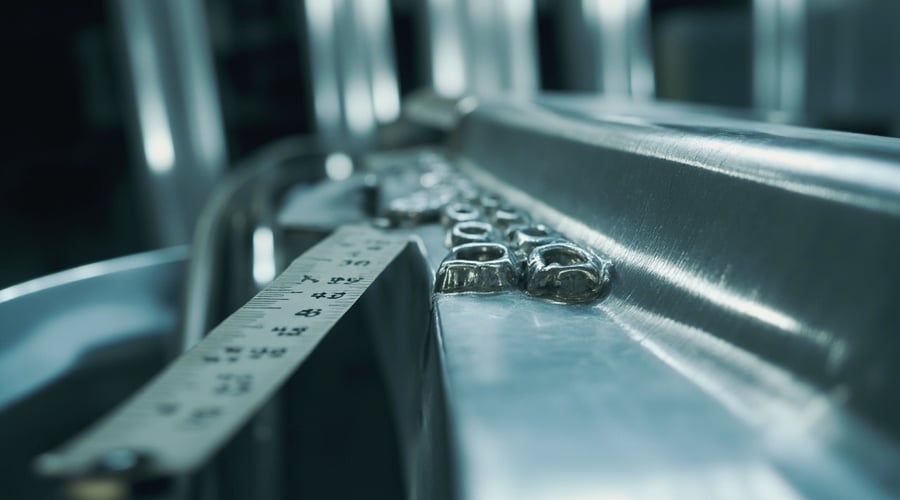
What a proper repair looks like: The weld line is clean, uniform, and positioned away from a pre-engineered crumple zone. The surrounding metal is straight — no ripple, no ghost creasing that suggests the section was pulled rather than replaced. The weld itself shows consistent penetration; it hasn't been built up with extra material to fill a gap. On many Japanese and European cars, the factory spot-weld pattern along the rail is a known reference — a repair section will show continuous MIG weld rather than a row of spot welds, which is normal and detectable. If the repair section is straight, the geometry checks out, and the weld is on an area of the rail that wasn't load-critical in the original impact zone, it can be an acceptable repair.
What a dangerous repair looks like: The weld is in the middle of a crumple zone — typically 200–400mm behind the front crossmember on most sedans and SUVs — and the surrounding metal shows residual distortion. The repair has been made with filler or undercoating applied over the weld to obscure it. On inspection, when you probe the area with a screwdriver handle (tapping for sound), you get a dull, inconsistent response where you'd expect solid metal. Sometimes the section was welded back without being properly straightened first, and you can see the rail isn't running true when you look along its length.
Our position in the workshop: a chassis rail repair that is outside the crumple zone, properly executed with no residual distortion, and disclosed — we'll put it on the lot with a clear note. A crumple zone repair, or any repair where the quality is doubtful, or where the rest of the inspection suggests the disclosed story doesn't match the damage pattern — that car goes back or gets repriced to reflect the risk.
The honest trade-off here: even a good chassis rail repair reduces resale value in Sydney. Buyers doing a PPSR will see a written-off history if it was recorded, and many won't proceed. If you're buying a car with known chassis work, you need to price that into your offer — not just into your safety calculation.
Guard Panel and Inner Guard Work: Reading the Repair Zone
A front-corner impact — the most common type in urban Sydney traffic — typically affects the guard panel, the inner guard, the suspension tower, and sometimes the firewall. The guard panel itself is bolt-on on most modern cars and can be replaced cleanly with no structural concern. The problem is what's behind it.
When our team removes a guard panel for inspection (we do this when there's any indication of front impact — rippling in the bonnet, paint inconsistency in the jamb, a wheel alignment pull that shouldn't be there), we're looking at the inner guard structure. This is a welded assembly that includes the suspension tower. If the suspension tower has been repaired, the weld quality and geometry are critical — this is where your front suspension loads. A tower that has been repaired without being properly realigned, or welded with inadequate penetration, will track badly and can fail under load.
The practical self-check a buyer can do before paying for a full PPI: stand at the front of the car and look along the bonnet line. Any twist, any asymmetry in how the bonnet sits relative to the guards, any variation in the gap widths, is worth noting. Open the bonnet and look at the bonnet hinges — impact distortion often shows first in the hinge mounting points. Look at the paint on the inside of the bonnet, the firewall face, and the inner guard — factory paint is textured and consistent. Repainted surfaces in this area, especially with overspray on wiring looms or rubber seals, are a clear indicator of work.
One thing Sydney buyers often miss: the A-pillar base and the scuttle panel (the area under the windscreen). In a significant front impact, these areas can pick up damage that doesn't get repaired because it's hard to reach and easy to hide with sealant. Our technicians probe this area on every car that comes in with any front corner history.
Sill Reinforcement: What It Reveals About Side Impact Severity
The sill — or rocker panel — runs along the bottom of each door opening. On a modern car it's a structural member that contributes to side-impact protection and roof crush resistance. On unibody vehicles, it also ties together the floor pan structure.
Cosmetic sill repair — dents, surface rust, minor stone chips — is unremarkable. What matters is when the sill has been reinforced: metal has been welded to the outside or inside of the existing sill to strengthen or reshape it after deformation. This is almost always a consequence of a side impact significant enough to push the sill in.
The warning signs from outside: look at the sill from door handle height, sighting along its length. A repaired sill often shows a slight bow or flat spot that the factory geometry doesn't have. Tap it along the length — solid box section has a specific resonance; filled or reinforced areas sound different. Open each door and look at the door seal channel and the bottom of the door — a pushed-in sill sometimes causes the door to bind or the gap to vary.
From underneath: weld seams on the outer sill that don't match the factory pattern, especially continuous runs of weld that are clearly not spot-welded at the factory spacing. Fresh undercoating applied to one side only is often a sign that work has been done and then covered.
The severity question on sill damage is: how far inward did the impact travel? A sill that took a hit and was reinforced without any floor pan movement can be acceptable. A sill where the floor pan shows distortion, or where the B-pillar base shows any crease, is a different category of damage and warrants much more careful evaluation — or a decision to walk away.
The Framework We Actually Use to Decide
When a car comes into our workshop and the inspection turns up weld marks or repair evidence, the conversation between our technicians and our buying team runs through a few consistent questions:
Does the repair zone match the disclosed history? If a seller says "minor front scrape" and there's a full inner guard replacement with tower repair, the histories don't match. Unexplained discrepancy is more concerning than the repair itself.
Is the weld quality consistent with a shop that cared? Amateur welds — insufficient penetration, spattering, variable bead width, repairs made without proper fixture — suggest the work was done to pass a visual inspection, not to restore structural integrity.
Has the geometry been checked after repair? Structural repairs that haven't been followed by a four-wheel alignment and laser frame check are dangerous even if the welding is adequate. We look at tyre wear patterns and pull behaviour as proxies when we can't verify the repair history.
What does the PPSR say? A car that is recorded as a statutory write-off in Australia cannot be re-registered in NSW — that's a hard line. A repairable write-off can be re-registered in NSW after passing an inspection, but the PPSR will carry that history permanently. Run the PPSR by plate number at ppsr.gov.au — it costs $2 and takes two minutes. Any buyer who doesn't do this is leaving a lot to chance.
What is the car worth with this history known? Structural repair history reduces market value in Sydney. The question is whether the price reflects that reality. A car with disclosed, quality chassis repair at a price that reflects it is a different proposition from a car with the same damage sold as clean.
What a Buyer Can Do Before Spending Money on a Pre-Purchase Inspection
You don't need to be a mechanic to do a first pass. Before you engage a third-party inspector or bring a car to us for a look:
-
Pull the PPSR at ppsr.gov.au by plate number. $2. Non-negotiable.
-
Sight along every panel from a low angle in sunlight. Parramatta Road on a clear morning is actually decent for this — the light is direct and low.
-
Open every door and look at the gap consistency from front to back. Factory assembly is tight and even. Repaired cars drift.
-
Look at the paint on inside surfaces — door jambs, boot opening, bonnet underside. Overspray, texture mismatch or fresh sealant in unexpected places is a tell.
-
If anything looks off, get the car on a hoist before you commit. A proper pre-purchase inspection in Sydney runs roughly $150–$250 depending on the inspector. That is not a cost — it is insurance against a far larger mistake.
The things you cannot check from ground level or a torchlit driveway inspection are the things that matter most. Chassis geometry, inner guard condition, sill box section integrity — these require a hoist and someone who knows what they're looking at.
If you've found a car you're considering and you want a second pair of eyes underneath — especially if there's anything in the panel work or the PPSR that's giving you pause — bring it in. We'll put it on the hoist and tell you what we see, straight.